Wednesday, March 17, 2010

Tibet Travel Guide

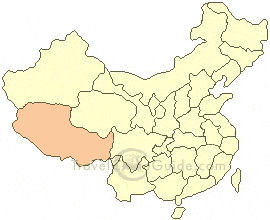
Tibet MapTibet (Xizang), the Roof of the World, remained unknown to the world until the beginning of the 20th century. The massive, snowy land has exerted an awesome draw on travelers and adventurers ever since. Its majestic scenery, mysterious and exotic religious culture, and wonderful people, reward every tourist with an indelible life long memory!

Tibet (Tibet Autonomous Region, TAR for short) borders Xinjiang, Qinghai, Sichuan and Yunnan internally while India, Burma, Bhutan, Sikkim, and Nepal meet its external borders. It covers a massive 1,220,000 square kilometers (470,920 square miles), which is about 12.8 % of the whole of China. With an average height of 4,000 meters above sea level, Tibet is encompassed by some of the world's highest mountains. The Himalayas to the south, the Karakoram to the west, and the Kunlun to the north are the dream lands of all adventurers and mountaineers.
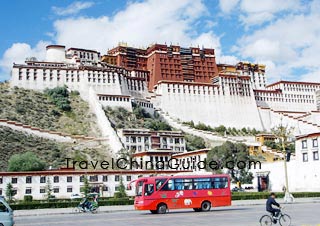
Potala Palace in LhasaThe vast land is also the cradle of several great rivers such as the Yangtze River, the Yellow River, the Nu River (Salween), the Lancang River (Mekong), the Yarlong Tsangpo (Brahmaputra), the Indus, and the Ganges. Tibet also offers awe-inspiring scenery of beautiful lakes and valleys. Over 1,500 lakes including Heavenly Lake Namtso and the holy Lake Manasarova make Tibet the plateau with largest amount of lakes. Without irrigation and nurturance of these rivers and lakes, the surrounding lands may not flourish.

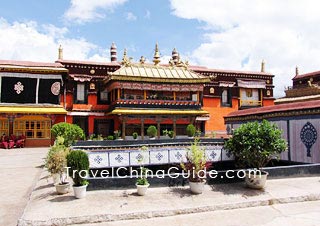
The long history and exotic religion allures more and more tourists every year. Tibetan Buddhism inhabits most Tibetans' hearts. Thus, a great deal of splendid monasteries, vivid murals and sculptures, and solemn stupas were built to worship the unparalleled Buddha. Lhasa and Shigatse, the most important cities of Tibet, feature most of the religious monuments including the Potala Palace, Jokhang Temple, Drepung Monastery, Sera Monastery, Ramoche Monastery, Tashilunpo Monastery and Sakya Monastery. Besides the monasteries, sacred mountains and holy lakes are also great places to show the Tibetan peoples' devotion to Buddha.

Western Tibet, Ngari, is a vast barren plateau and renowned as the Roof of Tibet. As the place where the Holy Lake (Lake Manasarova) joins the Sacred Mountain (Mt.Kailash), Ngari is a holy pilgrimage destination of both Tibetans and Hindus, as well as a popular challenge to trekkers. The ancient Shang Shung Kingdom and Guge Kingdom also exert a pull. As the climate is so inclement few people live in this region. Therefore, Ngari is also the home of wild yak, Tibetan antelope, wild donkey, and many other rare wild animals.
The Tibetan womenIn Tibet, five mountains exceed the altitudes of 8,000 meters (26,240 feet) and many of the mountains exceed the altitudes of 7,000 meters (22,960 feet). Hence, southwestern Tibet has been a popular destination for mountaineers. Mt. Everest towers over the region. Besides, more than 40 snow capped peaks are open to mountain climbing enthusiasts. Each year, thousands of adventurers and mountaineers come to Tibet to challenge both nature and themselves. Southern Tibet also offers primeval forests, running waters, and a relatively mild climate. Yarlong Tsangpo Canyon, the largest canyon in the world, is the home of rare plants and animals, and remains unknown to anyone other than the local people.

Tibetan people are warm and hospitable. Tourists can visit local families and experience the daily life of Tibetan people. Holidays and festivals are the most important days in Tibet. Enjoying the local food and dancing with beautiful Tibetan girls are the most excellent ways to celebrate these joyful times. Buying some typical handicrafts in Barkhor Street or from other authentic vendors may add extra happiness to your visit.

Beside white snow capped mountains, verdant virgin forests, clean running rivers and tranquil beautiful lakes, the devotional pilgrim progress toward their places of worship by prostrating themselves under the sky and along the roads, making people humble and modest. Tibet, the lost paradise under the sky, is undoubtedly a place where the spirit lives!

The already famous Tibet Railway that was completed last October has been officially set for operation from July 1, 2006. This miraculous engineering achievement will make Tibet, the mysterious and amazing sacred land with a thousand-year history, witness many changes leading to prosperity.

Following the opening of the Tibet Railway, 3,000 - 4,000 tourists are expected to travel to Tibet every day. It is anticipated that the railway will enhance tourism to both Qinghai Province as well as the Tibet Autonomous Region, thus bringing prosperity to that part of West China that until now has not enjoyed all the benefits attributable to the tourist industry. The new rail link provides the traveler with a more convenient, comfortable, safer and economical way to go to Tibet. In turn the railway will alleviate the pressure on exiting passenger transport during the peak period of the high season. The Tibet Railway offers the tourist the opportunity to see more of the wonderful landscape that is unique to the 'roof of the world'. By opening up the connection between Lhasa and Qinghai, the railway will not only give outsiders the opportunity to take Tibet tours but will also facilitate economical freight transport for the benefit of the Tibetan people as a whole.

The miraculous railway now closely connects mainland China and remote Tibet, which will speed up economic development. The Tibet Railway will not only bring about a significant change of the mystical view of the outside world to Tibet, but will also create a better cognition of the Tibetan people by the outside world. There is a strong belief that Tibet will welcome a better tomorrow thanks to this widely hailed sacred road.

See more shanghai tibet tours

Shaolin Temple

Shaolin Temple, in the region of Song Mountain, Dengfeng City, Henan Province, is reputed to be 'the Number One Temple under Heaven'. The temple is the cradle of the Chinese Zen Buddhism and the Shaolin Martial Arts such as Shaolin Cudgel. One can see wild flowers and pines on the mountain. With birds singing and a brook spattering, a beautiful scene full of life and vitality is revealed to the visitors.

Shaolin Temple embraces many exciting attractions, such as the Hall of Heavenly Kings (Tianwangdian), the Mahavira Hall (Daxiongbaodian), the Pagoda Forest, the Dharma Cave and the Shaolin Temple Martial Art Training Center. Visitors may follow the virtual guide about the Shaolin Temple.

First we see the Shanmen Hall. Hung on its top is a tablet reading 'Shaolin Temple'. The tablet was inscribed by the Emperor Kangxi (1622 - 1723) during the Qing Dynasty (1644 - 1911). Under the stairs of the hall crouches two stone lions made in the Ming Dynasty (1368-1644). The hall enshrines the Maitreya Buddha. Two sides of the corridor behind the hall's gate are paved with inscriptions on stone steles made during several different dynasties.

Next we arrive at the Hall of Heavenly Kings. The gate of the hall is guarded by two figures depicting Vajra (Buddhist warrior attendants). Inside the hall are figures of the Four Heavenly Kings who are responsible for inspecting peoples' behavior, helping the troubled, and blessing the people.

Mahavira HallThen we come to the Mahavira Hall. The complex's center is right before your eyes. Both important celebrations and regular prayers are held here. 18 Buddhist Arhats stand along the eastern and the southern walls of the hall. Buddhas of the Middle, East and West are enshrined in this hall, respectively Sakyamuni Buddha, Pharmacist Buddha and Amitabha Buddha. Figures of Kingnaro (the founder of Shaolin Cudgel) and Dharma (the founder of Chinese Zen Buddhism) stand beside those three Buddhas, a placement which is very different from other Mahavira Halls. At the feet of the pillars in this Mahavira Hall are stone lions that are more than one meter (about 3.33 feet) high. On the ground there are about 50 small pits, 20 centimeters (about 7.87 inches) deep. It is said that they are the footprints left by monks when they practiced Shaolin Martial Arts.
Unexpectedly, we come to the Pagoda Forest, a graveyard for Buddhist dignitaries through the ages. On average, the pagodas are less than 15 meters (about 49 feet) high. The layer and the shape of a pagoda depend on many factors, such as one's Buddhist status, attainment and prestige during his lifetime. The Pagoda Forest in Shaolin Temple is the largest of China's pagoda complexes.

Outside the temple we continue walking to the northwest, and then we will take a look at two monasteries, named the Ancestor's Monastery and the Second Ancestor's Monastery. The first monastery is built by a Dharma's disciple to commemorate Dharma's nine years of meditation in a cave. It has a big hall supported by 16 stone pillars on whose shafts are exquisitely carved warriors, dancing dragons and phoenixes. The second monastery is a nursing home of the second ancestor Huike who cut his left arm in order to show his sincerity to study Buddhism from Dharma. In front of the monastery are four springs created by Dharma to help Huike to fetch water easily. They are called 'Spring Zhuoxi' and each has its own distinctive flavor.

Pagoda ForestThe cave we see next is the Dharma Cave. In this cave Dharma patiently faced the wall and meditated for 9 years. Finally, he reached the immortal spiritual state and created the Buddhist Zen. The cave is seven meters deep (about 23 feet) and three meters high (about 9.8 feet). Many stone inscriptions are carved on both its sides. There is a Meditating Stone in the cave. It is said Dharma's shadow was reflected upon the stone and embedded on it because of the long time of his meditation facing the wall. Unfortunately the stone was ruined during the war.

After passing the Dharma Cave, we come to the Buddhist Living Quarters for transient monks. It is on the south bank of the Shaoxi River opposite the temple. First built in 1512 of the Ming Dynasty, it was repaired in the Qing Dynasty. The quarters are noted for the simple and distinctive design. It collapsed in 1958 and then repaired in 1993.

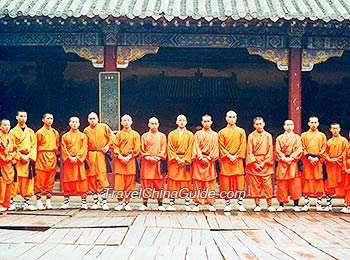
The Shaolin Temple Wushu (Martial Arts) Training Center comes last. Its perfect scenery makes it an ideal place for practicing the Chinese Shaolin Kung Fu. Shaolin monks have been practicing Kung Fu for over 1,500 years. The system was invented by Dharma who taught the monks basic methods to improve their health and defend themselves. The Martial art performance shows the true Chinese Shaolin Kung Fu. For example, Tong Zi Gong, performed by teenagers, is a kind of martial art to train one's flexibility and strength.

In a word, Shaolin Temple is worthy of a visit. It will give you a better understanding of Chinese Buddhism and the martial arts.

Keep Reading  Shanghai travel/ Travel in China

Jiuzhaigou Travel Guide

Located in the north of Sichuan Province, Jiuzhaigou County (previously known as Nanping County until being renamed in 1998) is part of the Aba Tibetan and Qiang Autonomous Prefecture. Since the opening of the Jiuzhaigou Valley Scenic and Historic Interest Area in 1984, visitors have flocked to the region year by year, and the prosperous tourist industry now accounts for a large proportion of local revenue.

Lying on the highest tableland in the world between the Sichuan Basin and the Qinghai-Tibetan Plateau, Jiuzhaigou Valley covers altitudes ranging from 2,000 meters (656,168 feet) to about 4,300 meters (14,107,612 feet). With its large number of lake groups, waterfalls and rich variety of endangered plants and fauna, Jiuzhaigou was awarded the status of UNESCO Man and Biosphere Reserve in 1997 and was also recognized as a UNESCO World Heritage Site in 1992. The reserve has received a string of other titles including that of a National Geological Park, a AAAA Class Scenic Spot in China and a Green Globe 21.

The charming scenery of Jiuzhaigou Scenic AreaWith some of the most beautiful and inspiring scenery on earth and some of the reserves scenic spots considered holy by the local Tibetan and Qiang people, it is no wonder a number of mysterious legends surround the wonderful landscape of Jiuzhaigou. Many people are drawn to the area for these reasons, and with the park open all year round the authorities have ensured that the fragile environment is sufficiently protected with a range of comprehensive tourist facilities.

In previous years it had been difficult for visitors to get to Jiuzhaigou due to its isolated location, however this is no longer a concern due to the construction of the Jiuzhaigou Ring Way which links the reserve with Chengdu and the Jiuhuang Airport, and has made gaining access to the park a great deal easier. Today most visitors transfer at Chengdu onto long-distance buses or flights going to Jiuzhaigou. The route on the ring way passes through a number of attractions and is surrounded by beautiful natural scenery, providing many a distraction for anyone making the journey. The route offers opportunities to enjoy the great Dujiangyan Irrigation Project, the beautiful Mt.Siguniangshan (Four Maiden's Mountain) Scenic Area and another of the world's most naturally stunning locations - the Huanglong Scenic and Historic Interest Area.

Historically, Jiuzhaigou has been home to small population of Tibetan and Qing people, and provides a good opportunity to get to know more about the locals' unique life and culture. The highlight of any trip to these areas are special performances laid on by the Tibetan and Qiang people which are also a popular form of nightlife in Jiuzhaigou. Moreover, trying some of the typical local foods and picking up a number of the reasonably-priced, locally-produced goods of the Tibetan and Qiang groups are something of a must on your trip.

Jiuzhaigou has been blessed with some of the most captivating landscapes on earth and words simply do not do it justice, and so you are encouraged to visit at the earliest opportunity.

Shanghai tours

Travel to Shanghai

Mt. Huashan

Situated in Huayin City, 120 kilometers (about 75 miles) east from Xi'an City of Shaanxi Province, Mt. Huashan is known as 'The Number One Precipitous Mountain under Heaven'. It is one of the five sacred mountains in China. The other four mountains are Mt. Taishan in Shandong, Mt. Hengshan in Hunan, Mt. Hengshan in Shanxi, and Mt. Songshan in Henan.

In ancient times, Mt. Huashan was called Mt. Taihuashan. From a distance the five peaks seem to form the shape of a 'flower' (hua in Chinese), hence the name 'Huashan'. It is famous for its natural vistas of steep and narrow paths, precipitous crags, and a high mountain range. It is home to several influential Taoist temples where emperors of past dynasties made pilgrimages, making Mt. Huashan the holy land of Taoism.

Yuquan Yuan (Jade Spring Temple)

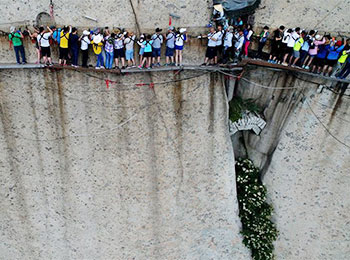
Usually tourists climb up the mountain assisted by the iron chains along the way and start their tour from Yuquan Yuan (Jade Spring Temple), one of the main Taoist temples in China located at the foot of Mt. Huashan. It has the architectural style of the classical gardens in south China. There is a pond in the center and several pavilions around it. Walking through the Wuyou Pavilion, the Long Corridor of Seventy-two Windows comes into view, and afterwards Qingke Ping where a big rock called 'Huixin Rock' can be seen. It is said that 'Huixin Rock' is a reminder for those who wish to stop their tour at this point. Beside the rock are the precipitous 370 rock steps called 'Qianchi Zhuang' considered to be the primary breath-taking path of Mt. Huashan. When climbing, only a gleam of sky above can be seen, making climbers feel as if they were at the bottom of a well.

North Peak (Cloud Terrace Peak)

Across the 'Qianchi Zhuang' are two similar precipitous paths-respectively called 'Baichi Xia' and 'Laojun Li' above which climbers reach Mt. Huashan's North Peak. There are precipitous cliffs on all sides of North Peak, making it look like a flat terrace in the clouds, hence the name Cloud Terrace Peak. It is 1,614 meters (about 5,295 feet) high. Three sides are cliffs and one side is to the 'Ca'er (the ear rubbing the cliff) Cliff' which is the fourth precipitous path where tourists can climb up only by pressing an ear close to the cliff. In the waist of North Peak trees are luxuriantly green, creating a good rest spot.

Jinsuo Guan (Gold Lock Pass)

Mount HuashanWhen climbing over the 'Blue Dragon Range', regarded as the must-pass way to the other four peaks from North Peak, travelers arrive at Gold Lock Pass. Mt. Huashan visitors know that it is customary to buy a golden lock, and then lock it in the iron chains on both sides of the Gold Lock Pass for families and friends to pray for their safety and health. It is a marvelous spectacle to see thousands of golden locks in the iron chains. Within the mountain gate of Gold Lock Pass, a huge golden lock of about 4 meters (about 4.37 yards) long and 1 .5 meters (about 1.64 yards) high stands in a big rock. It is made of pure copper and forged by 9,999 locks left by visitors. It is a popular photo site. This huge lock can only be opened by throwing coins - one coin represent the status of an ordinary person; three coins, a blessed person and nine coins a most blessed one. Gold Lock Pass is the throat to Middle Peak, East Peak, South Peak and West Peak.
Middle Peak (Jade Maiden Peak)

Middle Peak clings to East peak and is in the center of East, South and West Peaks. There is a Taoist temple in the peak named 'Jade Maiden Temple'. Legend has it that the daughter of Qin Mugong (569 B.C.-621 B.C.) loved a man who was good at playing Chinese tung-hsiao (vertical flute) and she gave up the royal life to become a hermit who cultivated her spirituality here, hence the name Jade Maiden Peak. Today Jade Maiden Temple and Jade Maiden Basin for Shampooing can be found on the peak.

Other scenic spots in Middle Peak include Rootless Tree and Sacrificing Tree which have beautiful stories and add to the supernatural atmosphere of Middle Peak.

East Peak (Facing Sun Peak)

Lotus Cave on the Mt. HuashanTour guides may promote climbing the mountain at night to see the sunrise. Climbing to the top of East Peak requires 4 to 6 hours. East Peak has an altitude of 2,090 meters (about 6,857 feet) forming a platform for visitors to view the sunrise. An astronomical telescope is provided here. The reference time for sunrise and sunset is 5:00a.m.-6:00a.m. in spring, 4:30a.m.-5:20a.m. in summer, 5:00a.m.-5:20a.m. in autumn, 5:30a.m.-6:00a.m. in winter.
One well-known scenic spot called the 'Immortal's Palm Peak of Mt. Huashan' which is ranked as one of the 'Eight Scenic Wonders of the Guanzhong Area (the plain area in the middle of Shaanxi Province)' is located on East Peak. It refers to the natural rock veins of the cliff which look like a giant palm-print. Legend has it that on March 3rd of the Lunar Calendar a torrential flood erupted, destroying the villages within the Mt. Huashan area. This disaster was caused by the Queen Mother of the West, who held her 'Flat Peach Carnival' celebration that year. She carelessly spilled a little jade wine down from paradise, causing a serious flood below. This news was quickly reported by Deity Shaohao to the Jade Emperor in Celestial Paradise. He gave a prompt order to Deity Juling to go down to tame the flood. When Deity Juling, full of vigor and vitality, descended from the clouds, he arrived at the precipitous cliff of East Peak. At the moment that he laid his left hand on one side and his right leg on the other, he ripped the mountain into two halves and immediately a flood rushed out. This tale adds luster to East Peak.421e350fad7b4d328793c9d1bcd21d72

Famen Temple

Famen Temple, renowned for storing the veritable Finger Bone of the Sakyamuni Buddha, is located in Fufeng County of Shaaxi Province, 120km east from Xi'an and 96km west from Baoji. With a history of 1,700 years, Famen Temple has been appraised the "Forerunner of Ziggurat in Central Shaanxi". Famen Temple Cultural Scenic Area, relying on Famen Temple mainly comprises four sectors including the Temple Gate Square, Foguang Avenue, Famen Temple, and the Namaste Dagoba. It is expected upon completion the Scenic Area will be the "No.2 Cultural Symbol of Shaanxi" next only to Terra-Cotta Warriors and Horses and stands out as the world-class cultural scenic area featuring the "Time-honored Buddhist Holy Land and Age-old Classic Buddhist Site".

Four Gates
Between Temple Gate Square and Foguang Avenue stand four gates, Foguang Gate, Prajna Gate, Bodhi Gate and Perfect Wisdom Gate. Foguang Gate is the place where the light of Buddha delivers all beings from torture and guides them to the Buddhist Faramita. Inside the Foguang Gate are the two still water pools named "Heart-Pacifying Pool." As sacred symbol of Buddhism, lotus living in the silt but not stained signifies the purity of Buddhists among the filthy world. Prajna refers great wisdom in Buddhism. The Prajna Gate means that during Buddhist medication, only by observing the guidance from prajna, can perfect wisdom and the most supreme Buddhist enlightenment be achieved. Bodhi means enlightenment and wisdom. By passing through the Bodhi Gate, one can be awakened to Buddha dharma and reach superior Buddhist cognition. The architecture design of Perfect Wisdom Gate, which only has gateposts, shows the Buddha dharma that is attained by observing sunyata (the nature of void). So, the Perfect Wisdom Gate is also called "Gate of Sunyata".

Foguang Avenue
Covering an area of 140,000sq km, Foguang Avenue is 1230m long and 108m wide. As the main axle, it divides the Scenic Area into the Western Section and the Eastern Section. The Eastern Section, named "Famous Site of Buddha", displays the whole process from the birth to the nirvana of Sakyamuni. The Western Section, named "Source of Buddhist Realm", exhibits the great advance of Buddhism ever since Sakyamuni's nirvana. Along the Foguang Avenue are the 10 statutes of well-known Bodhisattva.

Famen Temple
Built in Eastern Han Dynasty to enshrine Sakyamuni's sarira, Famen Temple, which was founded around the dagoba, was originally named "Asoka Temple." In Sui Dynasty, it was renamed "Chengshi Buddha Mandala". In Tang Dynasty, it was given its present name "Famen Temple". Later, by holding several ceremonies for enshrining the relics of Sakyamuni's finger bone, Famen Temple became well-know, and made its way into a world-famous Buddhist temple. The most representative structures in the temple are the Famen Temple Pagoda and Famen Temple Museum.

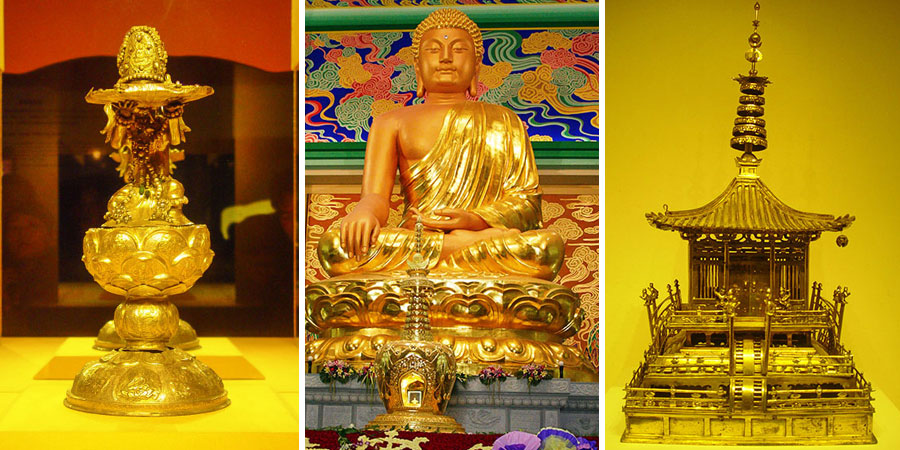
The exhibition in Famen TempleAt the center of the temple is the 13-tiered octagonal pagoda under which it is said, a sliver of the finger bone of Sakyamuni was discovered. In 1981, subsidence of the pagoda led to reconstruction, during which, an Underground Palace was discovered unexpectedly in 1987. Many royal treasures and jewellery were found here - more than 2,000 pieces surrounded the Tang mandala (geometric designs, usually circular, symbolizing the universe). The most precious one is the veritable Finger Bone of the Sakyamuni Buddha. At present, this is the biggest Buddhist underground palace so far discovered. From the grand architectural style, the Underground Palace is said to have been established in the Tang Dynasty (618-907). But why, and how such precious treasures were stored under the pagoda. Tracing back to a most flourishing time in Chinese history, formerly, Famen Temple was the royal temple during the Sui Dynasty (581-618) and Tang Dynasty. Emperors in Sui and Tang believed that enshrining and worshiping the bone of Sakyamuni would bring riches and peace to the land and its people. So an offering of treasure to the finger bone was made, it was housed in the Underground Palace.
Famen Temple Museum was established in 1987, which includes most of the precious treasures from the Tang Dynasty removed from Underground Palace, including gold and silverware, colored glaze ware, porcelain and silks. Owing to more and more tourists and their curiosity to the relics, two new exhibition halls were established in 2000. The exhibition area expanded from 500 square meters to 3,000 square meters.

Namaste Dagoba
Namaste Dagoba was completed on May 9, 2009 after 3 years construction. The Namaste Dagoba is used to enshrine the one and only relics of Sakyamuni's finger bone in the word instead of Famen Temple Pagoda. The full height of the dagoba is 148m, of which the three digits have its connotation. The "1" in the number symbols that the Buddha does not differ from all beings. The Buddha is the awakened beings while the beings are yet to be enlightened. The "4" and "8" in the number denote the 8th day of the 4th lunar month, the birthday of Buddha. The architecture design of Namaste Dagoba represents the Buddha thought of unification, concord harmony, and peace. The one and only relics of Sakyamuni's finger bone in the world was enshrined in the underground palace in the Namaste Dagoba. The finger bone will rise up on the first floor at the Namaste Dagoba in the 1st day and 15st day of each lunar month and Saturdays and Sundays for tourists and devotees to pay homage.

keep reading on Shanghai tours / Travel in China

Emperor Qin Shi Huang -- First Emperor of China

Emperor Qin Shi Huang (259 BC - 210 BC) fascinates people when they talk about the Great Wall and the Terracotta Warriors and Horses - his two greatest achievements to China. As the first emperor of China, he indeed has a profound influence on Chinese history and culture.

How did he come to the throne?

Emperor Qin Shi Huang, born as Ying Zheng in 259 BC, was the son of the king of the Qin State. At the age of thirteen, he succeeded his father's regality. Ying Zheng was very aggressive and ambitious at an early age. He assumed full power at 22 by ridding himself of his premier, Lu Buwei, who acted as regent while he was a minor. He wanted to unify and subjugate all the states like Han, Zhao, Wei, Chu, Yan and Qi by the powerful political, economic and military strength of the Qin State. Ying Zheng realized his ambition and built the first feudal and centralized empire in Chinese history in 221 BC. This was what we called - the Qin Dynasty (221 BC - 206 BC). Ying Zheng was the first emperor of a united China, so he proclaimed himself Qin Shi Huang.

"Qin Shi Huang"  

When Ying Zheng unified China, he considered his achievement surpassing the legendary "San Huang (three emperors)" and "Wu Di (five sovereigns)". He created a new title for himself: "Huangdi" together with "Shi (means the first)", hence get the name "Qin Shi Huang" or "Qin Shi Huangdi", which means he was the first emperor of China. He hoped his descendants would follow in his steps to rule China for eternity.


Achievements and Defects

In order to consolidate the nascent empire, Qin Shi Huang reformed politics, economy and culture. In politics, he abolished the hereditary vassal enfeoffment system and established prefectures and counties, ruled directly by the emperor. Based on the original rules of the Qin State, the emperor adopted some regulations of other rival states to form a workable law of the Qin Dynasty. In economy, he claimed that both the agriculture and commerce were very important. People should have them developed together. Besides, tax system began to function and coinage and metrology were all standardized. In culture, the emperor unified the Chinese characters in writing, which promoted the development of the Chinese culture. However, he also suppressed scholars who were not to his liking. Consequently, many scholars involved were killed in Xianyang.

Qin Terracotta Army
Qin Terracotta Army
The symbol of the Chinese ancient civilization, the Great Wall bears witness to Qin Shi Huang's centralism. He ordered conscript laborers to link together the defensive works against marauding nomads already built by the former states. That was the forerunner of the modern Great Wall. Another world-famous achievement is the Terracotta Warriors and Horses in Xian, which was discovered nearby the mausoleum of Emperor Qin Shi Huang. Both are the wonders of China. But during their construction, countless conscripts lost their lives. It's really wasting manpower and resources.

Decline of the First Emperor

Qin Shi Huang longed for longevity, so he sent his ministers to go on quests seeking for an elixir of immortality. However, death claimed him before he could find success on that matter. The emperor departed from the world of the living in 210 BC while traveling. The Peasant Uprising led by Chen Sheng and Wu Guang broke out soon after Hu Hai, the second generation, got onto the throne. Accordingly, the Qin Dynasty came to an abrupt end in 206 BC. Qin Shi Huang is truly an epoch-making historic emperor in China's history.

Terra Cotta Warriors and Horses

The Terra Cotta Warriors and Horses are the most significant archeological excavations of the 20th century. Work is ongoing at this site, which is around 1.5 kilometers east of Emperor Qin Shi Huang's Mausoleum in Lintong, Xian, Shaanxi Province. It is a sight not to be missed by any visitor to China.

Upon ascending the throne at the age of 13 (in 246 BC), Qin Shi Huang, later the first Emperor of all China, had begun to work for his mausoleum. It took 11 years to finish. It is speculated that many buried treasures and sacrificial objects had accompanied the emperor in his after life. A group of peasants uncovered some pottery while digging for a well nearby the royal tomb in 1974. It caught the attention of archeologists immediately. They came to Xian in droves to study and to extend the digs. They had established beyond doubt that these artifacts were associated with the Qin Dynasty (211-206 BC).

he State Council authorized to build a museum on site in 1975. When completed, people from far and near came to visit. Xian and the Museum of Qin Terra Cotta Warriors and Horses have become landmarks on all travelers' itinerary.

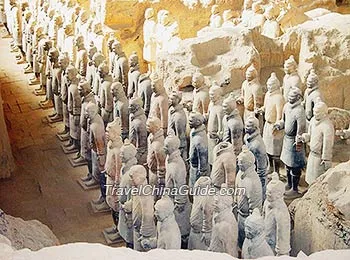
Life size terracotta figures of warriors and horses arranged in battle formations are the star features at the museum. They are replicas of what the imperial guard should look like in those days of pomp and vigor.

The museum covers an area of 16,300 square meters, divided into three sections: No. 1 Pit, No. 2 Pit, and No. 3 Pit respectively. They were tagged in the order of their discoveries. No. 1 Pit is the largest, first opened to the public on China's National Day, 1979. There are columns of soldiers at the front, followed by war chariots at the back.

No. 2 Pit, found in 1976, is 20 meters northeast of No. 1 Pit. It contained over a thousand warriors and 90 chariots of wood. It was unveiled to the public in 1994.Archeologists came upon No. 3 Pit also in 1976, 25 meters northwest of No. 1 Pit. It looked like to be the command center of the armed forces. It went on display in 1989, with 68 warriors, a war chariot and four horses.

Altogether over 7,000 pottery soldiers, horses, chariots, and even weapons have been unearthed from these pits. Most of them have been restored to their former grandeur.

The Terra Cotta Warriors and Horses is a sensational archeological find of all times. It has put Xian on the map for tourists. It was listed by UNESCO in 1987 as one of the world cultural heritages.

On October 10 2009, the 35th anniversary of the discovery of Qin Terracotta Warriors and Horses, the logo of the Emperor Qin Shi Huang's Terracotta Army Museum was announced to the public. The logo geometrically abstracts the terracotta warriors and horses, in which every warrior is generalized into a round dot, and the collective dots resemble the combat formation. Above the dots, a long curve stands for the vast vault and rolling Lishan Mountain. The overall design is exactly like the sealing earth of the Mausoleum and also implies that the Emperor Qin Shi Huang's Terracotta Army Museum is a part of the Emperor Qin Shi Huang's Mausoleum Site Museum.

In the meantime, the logo of the Emperor Qin Shi Huang's Mausoleum Site Museum was published. The design perfectly blends the appearance of the sealing earth of the Mausoleum with Chinese character "Qin" written in mini-seal script. The middle pattern is drawn from the decoration of the eaves tile in Qin Dynasty, and also highlights the strength of Qin military. The logo is a sign of the military culture in Qin Dynasty.

Reed Flute Cave

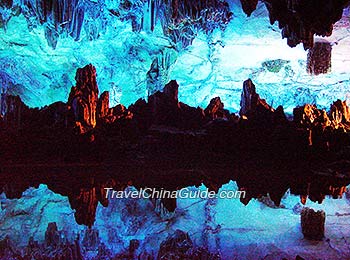
With its location five kilometers northwest of the downtown of Guilin, the Reed Flute Cave is a brilliant cave marked on almost all travel itineraries. The cave got its name from the verdant reeds growing outside it, with which people make flutes. Inside this water-eroded cave is a spectacular world of various stalactites, stone pillars and rock formations created by carbonate deposition. Illuminated by colored lighting, the fantastic spectacle is found in many variations along this 240-meter-long cave. Walking through the serried stone pillars, tourists feast their eyes on changing spots, feeling they are in a paradise where the Gods live.

Tourists enter the cave and then take a U-shaped sight-seeing route to see different spots, whereupon they exit it from another cave quite near the entrance one. One trip lasts about one hour. It is a Chinese habit to give each formation a legendary or poetic name such as Crystal Palace, Dragon Pagoda, Virgin Forest, Flower and Fruit Mountain and other interesting names. For some of these names, you need to use your imagination, but the story behind each is quite fun. It's a pleasure to listen to romantic or fairy tales whilst appreciating the fantastic stone formations. Both the stories and the lighting add mystery to the scene. Although there are different kinds of lighting inside, you are not supposed to take photos unless you are a professional photographer, because the light inside is not sufficient for exposure. At some spots, such as the Crystal Palace or Flower and Fruit Mountain, special photography is offered at 20 yuan for one picture. (They use special equipment to provide enough illumination.) Some 70 inscriptions on the cave wall are said to be travelogues and poems derived from the Tang Dynasty, which made the cave a popular tourist site at that time.

Spectacular interior scene of the caveThe illuminated cave looks like a fairyland.


Li River

Elephant Trunk Hill is located on the western bank of Li River. The shape of the hill is just like a huge elephant drinking water from the river with its trunk, so it is called Elephant Trunk Hill.

Shui Yue Cave (Water Moon Cave) is between the trunk and the legs, which is a semi-round cave penetrated by water. The inverted reflection of the cave in water plus the part above forms a full moon. This phenomenon is unique and many laudatory inscriptions were found on the wall inside the cave. Visitors can boat through the cave to the river.

Another cave regarded as the eyes of the elephant lies in the hillside. It provides tourists an ideal position to enjoy the panoramic view of Guilin.

On the top of the hill is a two-storey pagoda built in the Ming Dynasty (1368-1644) surrounded by green trees. The north seat of the second floor is inlaid with an image of Bodhisattva Puxian. The pagoda looks like a precious vase on the back of an elephant seen from distance and many beautiful legends about the pagoda with good wishes are said among people.Unique boats used for cruising on the river

As the symbol of Guilin, Elephant Trunk Hill is the main scenic spot of the Elephant Trunk Hill Park, which also includes Yunfeng Monastery (a building with ancient style), Aiqing Dao (Love Island) and so on.

Jade Buddha Temple

In the western part of Shanghai, a very modern and flourishing city, there is a venerable and famous Buddhist temple, Jade Buddha Temple. In 1882, an old temple was built to keep two jade Buddha statues which had been brought from Burma by a monk named Huigen. The temple was destroyed during the revolution that overthrew the Qing Dynasty. Fortunately the jade Buddha statues were saved and a new temple was built on the present site in 1928. It was named the Jade Buddha Temple.

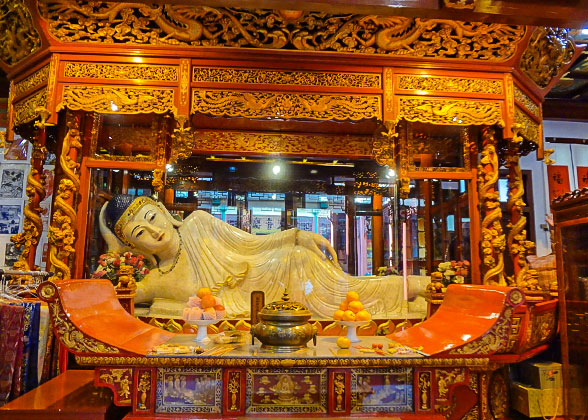
The two precious jade Buddhist statues are not only rare cultural relics but also porcelain artworks. Both the Sitting Buddha and the Recumbent Buddha are carved with whole white jade. The sparkling and crystal-clear white jade gives the Buddhas the beauty of sanctity and make them more vivid. The Sitting Buddha is 190 centimeters high and encrusted by the agate and the emerald, portraying the Buddha at the moment of his meditation and enlightenment. The Recumbent Buddha is 96 centimeters long, lying on the right side with the right hand supporting the head and the left hand placing on the left leg, this shape is called the 'lucky repose'. The sedate face shows the peaceful mood of Sakyamuni when he left this world. In the temple there is also another Recumbent Buddha which is four meters long and was brought from Singapore by the tenth abbot of the temple in 1989. Furthermore there are many other ancient paintings and Buddhist scriptures distributed in the different halls of the temple.

The Sleeping BuddhaAlthough the history of the Jade Buddha Temple is not very long, the old-time and classical architectural style makes the temple unique and inimitable in this modern city. Devajara Hall, Mahavira Hall and the Jade Buddha Tower make up the main structure of the temple and at sides are the Kwan-yin Dian Hall, the Amitabha Dian Hall, the Zen Tang Hall, the Dining-Room and the Recumbent Buddha Hall. The Sitting Buddha is in the Jade Buddha Tower and the Recumbent Buddhas are in the Recumbent Buddha Hall. More than 7,000 Dazang sutras are kept in the Jade Buddha Tower; these are all the inestimable culture relics.
The Jade Buddha Temple is a good place to go whether you are a Buddhist or not, the peaceful and transcendent atmosphere adds a kind of richness to our busy modern society.

Yuyuan Garden

Yuyuan Garden is a famous classical garden located in Anren Jie, Shanghai. The garden was finished in 1577 by a government officer of the Ming Dynasty (1368-1644) named Pan Yunduan. Yu in Chinese means pleasing and satisfying, and this garden was specially built for Pan's parents as a place for them to enjoy a tranquil and happy time in their old age.

In the 400 years of its existence, Yuyuan Garden had undergone many changes. During the late Ming Dynasty, it became very dilapidated with the decline of Pan's family. In 1760, some rich merchants bought Yuyuan Garden and spent more than 20 years reconstructing the buildings. During the Opium War of the 19th century, Yuyuan Garden was severely damaged. The Yuyuan Garden you see today is the result of a five year restoration project which began in 1956. The garden was open to the public in September, 1961.

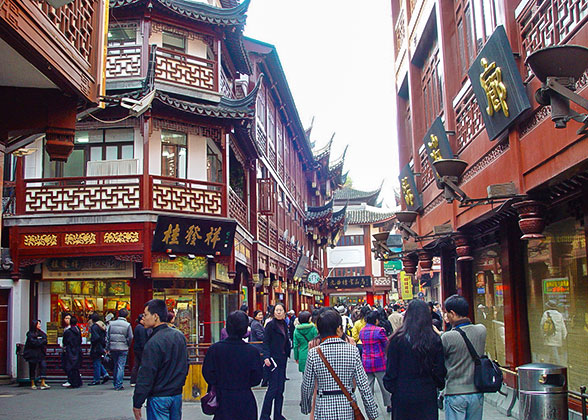
The outside of the Yuyuan Garden

Yuyuan Garden occupies an area of 20,000 square meters (about five acres). However, the small size is not a representative of the attractions of the garden. The pavilions, halls, rockeries, ponds and cloisters all have unique characteristics. There are six main scenic areas in the garden: Sansui Hall, Wanhua Chamber, Dianchun Hall, Huijing Hall, Yuhua Hall and the Inner Garden. Each area features several scenic spots within its borders.

Upon entering the garden, you will encounter a rockery, which is called the Great Rockery. With a height of 14 meters (about 50 feet), it is the largest as well as the oldest rockery in the southern region of the Yangtze River. On the top of the rockery, you can get a bird's eye view of the garden. Cuixiu Hall sits at the foot of the rockery. It is a quiet and elegant place surrounded by old trees and beautiful flowers. Visitors will find curio shops in the Cuixiu Hall.

Sansui Hall was built in 1760 and was originally used to entertain guests. Later it became a place to hold ceremonies for the gentlemen and bookmen. With a height of nine meters (about 30 feet) and featuring five halls, it is the largest and most commodious structure in the garden. The name Sansui is derived from the book History of the later Han Dynasty, and means 'propitious' and 'lucky'.

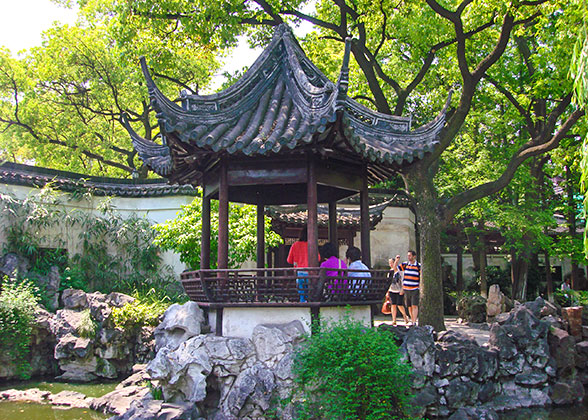
The picturesque scenery in the gardenWandering in the area of Yule Pavilion and Wanhua Chamber, you will find pavilions, corridors, streams, courtyards as well as many other natural features. Wanhua Chamber is a delicately chased building surrounded by derious cloisters. Spring bamboos grow beside the cloisters. In front of Wanhua Chamber, there are two old trees. One is a maidenhair tree which is 21 meters tall (about 70 feet).It is said that the tree was planted by the host of the garden 400 years ago.
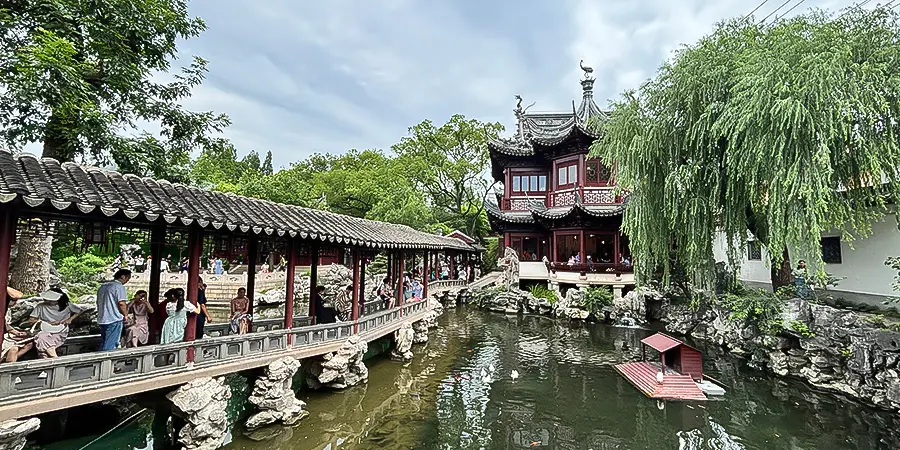
The Dianchun Hall area is located east of Wanhua Chamber, and includes Hexu Hall, Relic Hall, Ancient Well Pavilion, and the Acting-and-Sing Stage. Dianchun Hall was once the headquarters of Xiaodao Hui, a revolted group who fought against the government of the Qing Dynasty (1644-1911) during 1853-1855. The coins made by Xiaodao Hui and the bulletins they proclaimed are currently displayed in the hall.

The true treasure of Yuyuan Garden is the Exquisite Jade Rock. Located across from Yuhua Hall, it is one of the three famous rocks in the southern region of the Yangtze River. (The other two are Duanyun Feng in Suzhou and Zhouyun Feng in Hangzhou.) The rock is 3.3 meters (about 10.8 feet) in height and has 72 holes. Beautiful pool in the Yuyuan GardenWhat is interesting about this rock is that if you burn a joss stick just below the rock, the smoke will magically float out from all of the holes. Similarly, when you pour water into the rock from top, the water will flow out from each hole creating a spectacular sight to see. Pan Yunduan was very fond of the Exquisite Jade Rock, and he built Yuhua Hall facing the rock so it was convenient to sit in the hall and admire it. The furnishings in the hall were made of top grade rosewood of the Ming Dynasty, appearing both natural and graceful.

The Inner Garden was a separate garden built in 1709, but is now a part of Yuyuan Garden in the south. The Inner Garden is compact and exquisite, and the rocks, pavilions, ornamental ponds and flower walls offer some of the most attractive sceneries in Yuyuan Garden.

The Bund

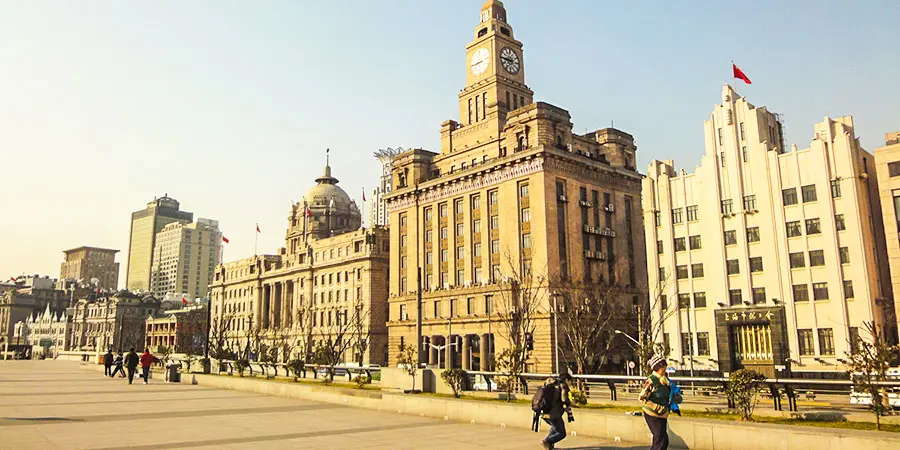
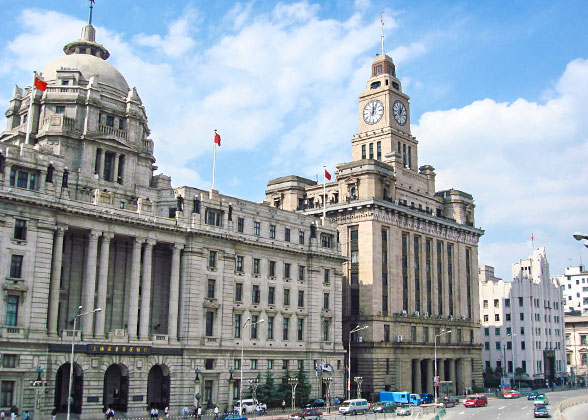
The Bund, also called the Zhongshan Dong Yi Lu (East Zhongshan 1st Road), is a famous waterfront and regarded as the symbol of Shanghai for hundreds of years. It starts from the Baidu Bridge, which is at the connecting point of the Huangpu River and the Suzhou Creek, to the East Jinling Road and winds a 1500 meters (less than one mile) length. Walking along the Bund, which is at the west shore of the Huangpu River, the Oriental Pearl TV Tower can be seen on the opposite side and also the Jin Mao Tower. Being one of the Top Ten Shanghai Attractions, the Bund is a really beautiful and special place which is worth visiting. The newly-built Flood Control Bank takes the function of preventing the oversize flood; the square with the statue of Marshal Chen Yi is an open air podium which gives new views of the Shanghai Plaza Culture; the Cenotaph which stands on the man-made island is a monument of people's heroes; the riverside greenbelt, the Electronic Waterfall Bell, and the Great Mural Carving are all representatives of the Bund. The most famous and attractive sight which is at the west side of the Bund are the 52 various buildings of different architectural styles including Gothic, Baroque, Romanesque, Classicism and the Renaissance.

 History of the Bund
Before the 1840s, the Bund was a muddy narrow lane with tall reeds. After Shanghai was established as the trading port in 1846, a street was paved there and the bank was reinforced. Then, rows of commercial buildings were constructed. As the UK Concession, the Bund is the starting point at which Shanghai walked into the modern times. It was the centre of Shanghai's politics, economy and culture hundreds of years ago, consulates of most countries and many banks, businesses and newspaper offices were settled there, and that's why we have these art-like buildings. Although they were not designed by the same person or built in the same period, the architectural pattern is similar.

The landmark of Shanghai - the Bund     The western-style architectures

Among the earliest banks established on the Bund, the most powerful ones are Jardine Mathrson & Co., Dent & Co. and David Sasson and Sons Company invested by Great Britain, and Russell & Co. sponsored by the United States. In 1868, today's Huangpu Park was set up there. At that time, it was named Bund Park, which is the oldest park in Shanghai. Until July 1st, 1928, the park started to be open to Chinese people. By 1930, the layout of the Bund had been formed.

On September 30, 1995, the Bund History Museum was opened. The museum collected many historical pictures as well as some representative literatures and tangible objects. It shows the 150 years' developing history of the Bund.

Brief Intro to the Famous Buildings on the Bund


The current East Wind Hotel on the Bund was founded up at the site of the exclusive Shanghai Club. It's a typical British classical architecture. It owned the longest bar counter at that time in a length of 110.7 inches. 

The Grecian igloo was the past HSBC Building. Built in 1923, the British people once said it's the most splendid building from Suez Canal to Bering Strait.

Today's Peace Hotel once was the famous Sasson House. It's a ten-storied building, 77 meters high. In the past, it was the tallest building on the Bund. In 1992, Peace Hotel was entitled the World Famous Hotel.

In order to make these architectures known by people, experts and scholars write nameplates for them both in Chinese and in English. Hereunder are the 25 famous old buildings on the Bund:

Summer Palace -- General Introduction

Situated in the western outskirts of Haidian District, the Summer Palace  is 15 kilometers (9.3 miles) from central Beijing. Having the largest royal park and being well preserved, it was designated, in 1960 by the State Council, as a Key Cultural Relics Protection Site of China. Containing examples of the ancient arts, it also has graceful landscapes and magnificent constructions. The Summer Palace is the archetypal Chinese garden, and is ranked amongst the most noted and classical gardens of the world. In 1998, it was listed as one of the World Heritage Sites by UNESCO.

Constructed in the Jin Dynasty (1115-1234), during the succeeding reign of feudal emperors; it was extended continuously. By the time of the Qing Dynasty (1644-1911), it had become a luxurious royal garden providing royal families with rest and entertainment. Originally called 'Qingyi Garden' (Garden of Clear Ripples), it was know as one of the famous 'three hills and five gardens' (Longevity Hill, Jade Spring Mountain, and Fragrant Hill; Garden of Clear Ripples, Garden of Everlasting Spring, Garden of Perfection and Brightness, Garden of Tranquility and Brightness, and Garden of Tranquility and Pleasure). Like most of the gardens of Beijing, it could not elude the rampages of the Anglo-French allied force and was destroyed by fire. In 1888, Empress Dowager Cixi embezzled navy funds to reconstruct it for her own benefit, changing its name to Summer Palace (Yiheyuan). She spent most of her later years there, dealing with state affairs and entertaining. In 1900, it suffered again, being ransacked by the Eight-Power Allied Force. After the success of the 1911 Revolution, it was opened to the public.

Composed mainly of Longevity Hill and Kunming Lake, The Summer Palace  occupies an area of 294 hectares (726.5 acres), three quarters of which is water. Guided by nature, artists designed the gardens exquisitely so that visitors would see marvelous views and be amazed by perfect examples of refined craftwork using the finest materials.

Centered on the Tower of Buddhist Incense (Foxiangge) the Summer Palace consists of over 3,000 structures including pavilions, towers, bridges, and corridors. The Summer Palace can be divided into four parts: the court area, front-hill area, front-lake area, and rear-hill and back-lake area.

Front-Hill Area: this area is the most magnificent area in the Summer Palace with the most constructions. Its layout is quite distinctive because of the central axis from the yard of Kunming Lake to the hilltop, on which important buildings are positioned including Gate of Dispelling Clouds, Hall of Dispelling Clouds,  Hall of Moral Glory, Tower of Buddhist Incense,  the Hall of the Sea of Wisdom, etc.

Rear-Hill and Back-Lake Area: although the constructions are fewer here, it has a unique landscape, with dense green trees, and winding paths. Visitors can feel a rare tranquility, and elegance. This area includes scenic spots such as Kunming Lake and Back Lake , which presents a tranquil beauty, Garden of Harmonious Interest , built by imitating the layout of Southern China's classical gardens, and Suzhou Market Street, endowed with a strong flavor of the water town Suzhou.

Court Area: this is where Empress Dowager Cixi and Emperor Guangxu met officials, conducted state affairs and rested. Entering the East Palace Gate, visitors may see the main palace buildings: the Hall of Benevolence and Longevity served as the office of the Emperor, the Hall of Jade Ripples where Guangxu lived, the Hall of Joyful Longevity, Cixi's residence, the Garden of Virtue and Harmony where Cixi was entertained, Yiyun House , where once lived the Empress Longyu, and Long Gallery, which measures the longest in Chinese gardens.

Front Lake Area: covering a larger part of the Summer Palace, opens up the vista of the lake. A breeze fluttering, waves gleam and willows kiss the ripples of the vast water. In this comfortable area there are the Eastern Bank and Western Bank, Seventeen-Arch Bridge,  Nanhu Island, the largest island in Summer Palace, Bronze Ox, an imposing statue beside the lake, and Marble Boat, built in western style with elaborate decorations . On the western bank float six distinct bridges amongst which the Jade-Belt Bridge is the most beautiful.

Forbidden City -- General introduction

Lying at the center of Beijing, the Forbidden City, called Gu Gong in Chinese, was the imperial palace during the Ming and Qing dynasties. Now known as the Palace Museum, it is to the north of Tiananmen Square. Rectangular in shape, it is the world's largest palace complex and covers 74 hectares. Surrounded by a six meter deep moat and a ten meter high wall are 9,999 rooms. The wall has a gate on each side. Opposite the Tiananmen Gate, to the north is the Gate of Divine Might (Shenwumen), which faces Jingshan Park. The distance between these two gates is 960 meters, while the distance between the gates in the east and west walls is 750 meters. There are unique and delicately structured towers on each of the four corners of the curtain wall. These afford views over both the palace and the city outside.

The Forbidden City is divided into two parts. The southern section, or the Outer Court was where the emperor exercised his supreme power over the nation. The northern section, or the Inner Court was where he lived with his royal family. Until 1924 when the last emperor of China was driven from the Inner Court, fourteen emperors of the Ming dynasty and ten emperors of the Qing dynasty had reigned here. Having been the imperial palace for some five centuries, it houses numerous rare treasures and curiosities. Listed by UNESCO as a World Cultural Heritage Site in 1987, the Palace Museum is now one of the most popular tourist attractions world-wide.

Construction of the palace complex began in 1407, the 5th year of the Yongle reign of the third emperor of the Ming dynasty. It was completed fourteen years later in 1420. It was said that a million workers including one hundred thousand artisans were driven into the long-term hard labor. Stone needed was quarried from Fangshan, a suburb of Beijing. It was said a well was dug every fifty meters along the road in order to pour water onto the road in winter to slide huge stones on ice into the city. Huge amounts of timber and other materials were freighted from faraway provinces.

Ancient Chinese people displayed their very considerable skills in building the Forbidden City. Take the grand red city wall for example. It has an 8.6 meters wide base reducing to 6.66 meters wide at the top. The angular shape of the wall totally frustrates attempts to climb it. The bricks were made from white lime and glutinous rice while the cement is made from glutinous rice and egg whites. These incredible materials make the wall extraordinarily strong.

Since yellow is the symbol of the royal family, it is the dominant color in the Forbidden City. Roofs are built with yellow glazed tiles; decorations in the palace are painted yellow; even the bricks on the ground are made yellow by a special process. However, there is one exception. Wenyuange, the royal library, has a black roof. The reason is that it was believed black represented water then and could extinguish fire.

Nowadays, the Forbidden City, or the Palace Museum is open to tourists from home and abroad. Splendid painted decoration on these royal architectural wonders, the grand and deluxe halls, with their surprisingly magnificent treasures will certainly satisfy 'modern civilians'.

Hutong Beijing

People say that the real culture of Beijing is "the culture of hutong" and "the culture of courtyard". How true that is. Often, it is Beijing's winding hutongs that attract tourists from home and abroad rather than the high-rise buildings and large mansions.

Hutong is a typical lane or small street in Beijing that originated during the Yuan Dynasty (1271-1368). "Hutong" is a Mongolian word, meaning "water well". During that time, water well is the settlement around which people lived. There are tens of thousands of hutongs surrounding the Forbidden City. In the past, Beijing was composed of countless courtyards. Hutongs were formed when people left a passageway between two courtyards to make entering them more convenient.

As the symbol of Beijing City, a hutong has its own layout and structure, which makes it a wonder in the world. When taking a bird's eye view of Beijing, you will find the combination of hutongs and courtyards just like an orderly chessboard with delicate gardens, fine rockeries, and ancient ruins. Hutongs have witnessed the development of Beijing. Where there is a hutong, there is a story.


Tourists traveling by rickshaw Hutong tour

Among the numerous hutongs in Beijing, Beixinqiao Hutong has the most turns. There are more than 20 in which you can easily get lost. The narrowest is Qian Shi Hutong (Money Market Hutong), measuring about 30 to 40 meters (32 to 44 yards), located in Zhubao Shi Street outside the Front Gate. The narrowest part is merely 40 centimeters (16 inches) wide, so when two people meet, they must turn sideways to pass each other. The longest one is Dong Jiaomin Hutong, with a total length of 6.5 kilometers (4 miles), lying between Chang'an Avenue and East Street and West Street of the Front Gate. The shortest one is Guantong Hutong measuring about 30 meters (33 yards).

Come and see it by hiring the rickshaw, and you'll have a true taste of Beijing!

guilin china

Just as Xian is a must when you travel to China, so is Guilin. The stunning landscape in which the city is situated has a kind of magic that is all its own. The strangely shaped hills, or karsts, with the verdant vegetation ranging from bamboo to conifers together with wonderful caves make Guilin such an attraction for tourists.

Located in the northeast of Guangxi Zhuang Autonomous Region, Guilin is considered to be the pearl of China's thriving tourist industry on account of the natural beauty and historic treasures. Covering an area of about 27,800 square kilometers (10,734 square miles), the city is rather compact when compared with other leading cities in the country. However, situated within this area one may find green mountains, crystal clear waters, unique caves and beautiful stones.Li River Major attractions include Elephant Trunk Hill, Li River, Reed Flute Cave and Seven-Star Park that boasts a Stone Museum where amazing geological finds are displayed. Believe that each of these places and many other attractions will leave you the lasting memories.

Guilin is also an important cultural city with a history encompassing more than 2000 years. The city has been the political, economic and cultural center of Guangxi since the Northern Song Dynasty (960-1127). Solitary Beauty Peak is considered to be the oldest place of interest and has been so since the far off days of the Southern Song Dynasty (1127-1279). The prosperity enjoyed by the city during the Ming Dynasty (1368-1644) is epitomized by the Tomb of Prince Jingjiang.

Guilin City

The many ethnic minorities represented here that include the Zhuang, Yao, Hui, Miao, Mulao, Maonan and Dong enrich the cultural life of the city. Each minority has its own unique customs and festivals and this means that they are much more abundant here than in many other places elsewhere in China. Travelers can enjoy these pageants at the Li River Folk Customs Center.

Guilin is a well-developed tourist center with convenient transportation, communication and accommodation facilities. You can enter Guilin by air, by train or by bus and get around on free buses. From luxury hotels to hostels, from splendid restaurants to local snacks, you are sure to find that your needs will be met beyond your expectations.

Beijing dining

Cuisines from many different cultures permeate the Beijing dining scene. With literally thousands of restaurants available, dining choices are practically unlimited. And the best part is that you can splurge at a fancy restaurant or dine supremely well (any much more cheaply) at any of the smaller family-run operations located all over the city.

Beijing Roast Duck

It is said that there are two things that you must do when visiting Beijing: One is to enjoy the roast duck and the other is to take a stroll on the Great Wall. There is simply quite nothing like a perfectly roasted duck with bronzed crispy skin and tender, succulent meat. There are literally dozens of restaurants that serve this famous dish, but perhaps the best known are Quanjude and Bianyifang.

Beijing Imperial Court Food

Imperial Cuisine has evolved over time to be enjoyed by all of the country's people, characterized by complex preparation techniques, the freshest ingredients and elaborate presentation including colorful vegetable carvings. It is the foundation of Beijing cuisine. Probably the finest expression of classic imperial cooking is the Tan Jia cuisine served at the Beijing Hotel.

Beijing Snack

Fancy Beijing snack is a must in tasting the authentic Beijing flavor. These dishes emanate from many different cuisines, but the Chinese Muslim influenceis the most apparent. There are probably 200 varieties of snacks in Beijing. Most of the snacks can be found throughout the city. Here, let us begin a snack tourto seek most delicious snacks of Beijing.

Chinese Cuisines

Beijing Restaurant Besides of the eight cuisines, most of regions and minorities in China also have their own particular cuisines that supply customers with more choices. For example, the delicate Shanghai, Huaiyang and Chaozhou cuisines, the unconstrained Shaanxi, Shanxi and Dongbei cuisines as well as the exotic Moslem and Uygur cuisines. In Beijing, it is easily to find such a kind of restaurant for dinner. Here is a bilingual menu which can help ordering dishes in restaurants.

Huangpu River

Huangpu River is a branch of the lower reaches of the Huangpu River YangtzeCruise. Located in the city of Shanghai, formerly known as Huangxiepu or Chunshen River. It comes from Taihu Lake, runs eastward through Lake Dianshan in Qingpu County and then flows Minhang in Shanghai. In the Baidu Bridge in the city center of Shanghai, Huangpu flows with the Wusong River (ie, Suzhou River) and flows into the East China Sea.

The Huangpu River winds like a dragon from Wusong rolling in the Baltic Sea. The yellow river with no ice is 114 kilometers (about 71 miles) long and 400 meters (0.25 miles) wide with an average depth of nine meters (30 feet). It joins 29 kilometers (18 miles) north of central Shanghai and divides Shanghai into two parts, east and west. Shanghai Pudong and PuXi appeal.

The Huangpu River is a multi-functional flow values of drinking water, navigation, fisheries, flood drainage, tourism and many other aspects. The famous port of Shanghai is located in this river. In recent decades, it has developed Shanghai Huangpu Port Cruise with the lagerst capacities in China

The Huangpu River is not only the mother river of Shanghai, and the Assembly of tourist attractions. In Shanghai, the Huangpu River, a program of traditional tourist cruises. Cruises are available daily, including shorter cruises (navigating the waterfront area between the bridge and Yangpu Nanpu Bridge) and the complete cruises (meandering eastward along the golden road, just 60 kilometers or 37 miles). The cruise begins with the federal government and is happening. To the south, go look at the Nanpu Bridge and then turns to the north of the Yangpu Bridge, and finally go Wusong Mouth (Wusongkou) resulted in entry flows into the Huangpu River and Yangtze River. When the flood comes, you can combine the beautiful game  three waters  C gray-blue waters of the Huangpu River to see the blue water of the East China Sea, and the yellow water with mud Yangtze River. The famous Oriental Pearl TV Tower, the highest TV tower in Asia and is the third largest in the world is betweeThe Western-style building from the Huangpu Rivern Nanpu Yangpu and bridges. It is a beautiful picture of  two dragons playing ball.
 During the cruise, you can see the obvious differences in architecture between the east bank and West Bank. Seen in the West Bank, many Western-style buildings are filled with exotic flavors, while the east side, rows of tall buildings to jump and climb above the clouds. Whether day or night, the scenery along the river are also nice. The great modern skyscrapers and buildings of typical styles are the best reports on the development of the city and the river Huangpu, the birthplace of Shanghai, is the faithful witness.

Local Life Style in Shanghai

Early in the morning, Shanghai's elderly can be seen in mass heading to Shanghai's parks and the People's Square to do morning exercises, often with grandchildren in tow. They can be seen in groups practicing tai chi, performing martial arts, doing local dances, and playing croquette. It is a site that can be seen throughout China. Two traditional pastimes that are unique to Shanghai is the ancient art of Ping tan and Shanghai Opera. Ping tan is a form of storytelling that traditionally has only one performer. The performer sits on the stage with only a couple of props used to emphasize what he is saying, and tells love tales, or tales of the daring exploits of legendary Chinese figures. This is very popular among Shanghai's elderly men, who often go to the Yuyuan Garden's Teahouse to enjoy this performing art. Shanghai's Local Opera is also popular amongst the elderly, and they enjoy watching performances in the evenings. In the evening, many middle aged and elderly people can be seen doing western style dance like the tango and cha cha in the parks well into the evening.

Shanghai locals are known for their hard work, but after work, they really like to play, and it is at night that Shanghai truly shines. Most of Shanghai's ancient and modern buildings are lit up at night, and the scene is quite spectacular. It is the perfect time for local lovers to take a cruise on the Huangpu River which flows through the city and passes by the Bund and the Oriental Pearl tower, which look particularly beautiful at night. The younger crowd likes to head out to be seen at Shanghai's numerous bars and nightclubs. Shanghai's nightlife is world-renown and is something the locals take very seriously. The most hopping nightlife spots can be found on Julu, Xintiandi, and Hengshan Roads. Many of Shanghai's fashionable young ladies like to spend the evenings shopping in Shanghai's many boutiques on Shanghai's Nanjing and Huanhai Roads.

Among Shanghai's working class, many sports have become quite popular. Due to the influx of Western businessmen and visitors, Western sports have become vogue, and like in the west, Golf, and Tennis are a necessity for Shanghai businessmen. Although expensive, golf courses are becoming more and more popular, and are normally designed to exacting specifications. The most popular golf courses amongst Shanghai's businessmen are the Palm Beach Golf Course, and the Shanghai Golf Club.


Travel After the Recession

Travel is wonderful and interesting; on the other hand, it will cost a large amount of money. However, if you are a person who research and make detailed plan in advance, much money will be saved. Wish this article will enlighten you in some degree and give you some value ideas.


Transportation fare always takes a large account of your travel budget, especially, flight fares. But if you know the tips about booking flight, you will get a good discount and save much money. The first tip is book flight as early as possible. If you're looking for an international ticket, the shopping can start five to six months beforehand because Airlines start releasing cheap seats four or five months before departure. Second, it will be cheap if you book round trip flights from the same airline company. 


When your itinerary is complex and includes many cities, you should consider carefully by which vehicle you will take. Once the distance from two cities are long enough, the economical way is taking the train overnight for it can not be much cheaper than flight but also save one night accommodation fare. And the soft sleeper is not as bad as you think. 


If you are traveling to some place for the first time, especially, traveling in a foreign country, travel agency can not only give you a reasonable plan but also save much money for you. They are more familiar with the local place than you and they have professional operators to arrange and design your tour. Apart from these, because they always deal with hotel and airline companies, they always can get good price than you. In fact, many hotels give a much cheaper price to travel agencies than direct customers for travel agencies are their big and regular customers. It is much like the price for retail and wholesale. So travel agencies can save money for you.


see more on shanghai world expo 2010 | China discount tours

My travel plans

Recently I have plans to travel to shanghai in 2010, and I would like to share some information about Shanghai.


Shanghai in the center of China's eastern coastline is one of China's cultural centers and has a long history as a trading port and gateway for foreigners entering China. It is the gateway to the Yangtze River delta. It is a municipality under the direct jurisdiction of the Central Government and the largest economic and trade center in China.


China's biggest and most prosperous city oozes an atmosphere of vitality and a dynamic which can rival New York in the United States and Paris of France in terms of modernity.


Shanghai's gorgeous night scene is one of the main highlights that will linger in visitors' mind owing to its ornate feature after their Shanghai travel experience. As night descends the entire city is lit up by dizzily colorful lights joined occasionally by the bright moon hanging in the sky.


Shanghai retains China's last vestige of its unusual colonial past. The foreign architecture standing along the Bund area is living museum of the colonial history of the 1800s. Many visitors find them immersed in thoughts of a bygone time as they strolling Shanghai's waterfront Bund area during their Shanghai travel.


Since winning the bid for World Expo 2010, Shanghai has been busy preparing itself and all necessary work is well in hand. The world has given China and Shanghai the opportunity to host this prestigious event and it will be well prepared when the time come. The hospitable Shanghai and its friendly people are always ready to receive people from all over the world and travelers are more than welcomed to travel Shanghai.


In a word, if you are tired of reading this, just find good travel agencies to help you. They can help you save money. If you want to go to China, visit www.tourochina.com or www.shanghaifocus.com, you will get more information.


Guangzhou

Guangzhou, the South Gate of China, is a prosperous metropolis full of vigor.

Guangzhou is the capital city of Guangdong, and the center of its political, economic, scientific, educational and cultural life. Sui (Ears of Rice) is short for Guangzhou and the City of Ram (Yang Cheng) is also an alias of Guangzhou. The kapok is the city flower and the kapok tree is the city tree of Guangzhou.

Guangzhou is located in the middle south of Guangdong Province, north of the Pearl River Delta. It lies close to the South China Sea, Hong Kong, and Macau. Zhujiang (The Pearl River), the third largest river of China, runs through Guangzhou and is navigable to the South China Sea. Situated in such an excellent geographical region, Guangzhou is called China's South Gate.

Covering an area of 7434.4 square kilometers (2870 square miles), Guangzhou is home to more than 11 million people, including a 3.7 million transitory population. With the opening of China to the outside world, a large number of people from other regions of China swarmed into Guangzhou, one of the first 'open' cities in China. This has accelerated its economic development.

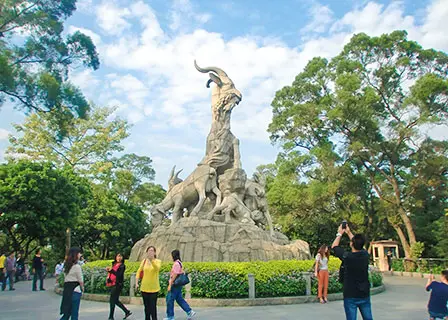
Sculpture of the Five Rams
Five Rams Sculpture
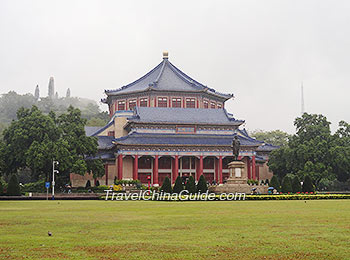
Sun Yat-sen Memorial Hall
Sun Yat-sen's Statue
Guangzhou is a famous historical city. In ancient days, Guangzhou was the capital city for three Chinese dynasties: the Nan Yue (South Yue), the Nan Han (South Han) and the Nanming (South Ming). Thus it was put in the list of the 24 most famous historical cultural cities and became a tourist destination. You can not understand most Chinese cities deeply until you know their history. This is true of Guangzhou. Many historic sights: the Western Han Nanyue King's Tomb Museum, the Zhenhai Tower and the Sun Yat-sen Memorial Hall tell us the 2,000-year history of Guangzhou.

Today, Guangzhou retains its ancient customs, but is also a large city full of vigor and current fashions. You can find something worth taking home in Shangxia Jiu Lu, Beijing Lu and Di Shi Fu Lu.

Trying Yue Cai (Cantonese Cuisine), one of eight Chinese famous cuisines, is definitely a must in Guangzhou! Eat delicious food with ingredients you have never heard of.

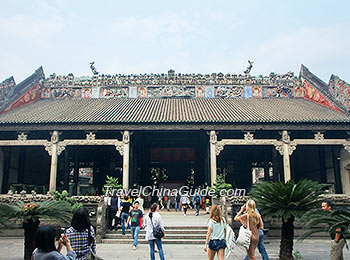
Chen Clan
Chen Clan's Academy
Hotel facilities and service in Guangzhou are fine. A word of warning: Do make a reservation beforehand if you decide to visit Guangzhou during the Canton Fair. For visitors, especially those plan to attend the Canton Fair, transportation in Guangzhou is more and more convenient. You can choose plane, train, ship or bus.

Guangzhou is famous as a hometown for overseas Chinese. It boasts the largest population of overseas Chinese people. These overseas Chinese do a great deal of good for Guangzhou: opening international markets, bridging Guangzhou and the rest of the world, and establishing many schools, hospitals, nurseries, kindergartens and rest homes in Guangzhou.

Keep reading on shanghai tours

Tsim Sha Tsui

Known as 'the paradise of shoppers', Hong Kong is famous for its fast developing economy. Visiting this modern metropolis, you could feel its vibrancy and have a good understanding of the local culture. In Hong Kong, there are many prosperous areas, and among them, Tsim Sha Tsui, located in the south of Kowloon Peninsula, Hong Kong, is one of the most famous.

As one sentence describes, Tsim Sha Tsui is a concentration of stores, shopping malls, restaurants and office buildings. Whenever you walk in the street, you will be confronted by heavy traffic and the crowd of citizens and tourist. But everything is very orderly.

Nathan Road is the leading road of Tsim Sha Tsui. Meanwhile, other streets radiate from there. Many international brands are grouped in those streets. Especially, the Park Lane Shopper's Boulevard which is intended for shopping, and young people like to roam there to buy some fashionable clothes. For those tourists who like to buy cosmetics, going to the cosmetic stores in Granville Road and Harbor City will bring them more surprise.

Also you can have a full vision of the Victoria Bay in this area, and the recommended attractions are the Avenue of Stars and Tsim Sha Tsui Beach. The Avenue of Stars was designed according to the one built in American Hollywood. The list of honored stars of Hong Long was inlaid into the surface of avenue. The Tsim Sha Tsui Beach seems more charming in the evening. Varied neon lights mingle together to make the night become another colorful world.

Additionally, the Hong Kong Museum of Art, the Hong Kong Space Museum and the Cultural Center lie here. All those things make Tsim Sha Tsui be an area of entertainment, shopping and education. So the tourists to go to Hong Kong should not miss visiting here.

Catering: Steamed dumplings, steamed stuffed buns, cakes, soup, seafood dishes, etc.

How to get there: Take the subway and get off at Tsim Sha Tsui or take the Star Ferry to the destination. And the traffic in Hong Kong is quite convenient, so you can reach your destination very easily.

→Avenue of Stars

The Avenue of Stars, located in Tsim Sha Tsui East, Kowloon, was built to showcase Hong Kong's movie industry, its history, movie stars and those working behind-the-scenes. It is a waterfront promenade, 440 meters (481 yards) long, extending from the Hong Kong Museum of Art to the New World Centre. Completed in April of 2004 at a cost of HK$40,000,000, its architecture was modeled after the Avenue of Stars of Hollywood, USA.

There are 73 movie celebrities' tablets inlaid on the surface of the avenue. 30 celebrities also left their handprints on their tablets, including Jackie Chan, Jet Lee, and Andy Lau. Standing on the avenue is a 3-meter bronze statue of Kung Fu Star Bruce Lee. Hong Kong was the starting point of his movie career. He left here for Hollywood and made several very famous Kung Fu movies enjoyed by audiences around the world. 

At the entrance to the avenue stands a bronze simulation of an Oscar statue and a small stage for performances. Walking along the avenue, visitors can find many snack shops, souvenir booths, some statues relating to movies and benches to sit and rest. There are roaming "Star Ambassadors" on roller skates, offering assistance when needed.

Promenading on the avenue, there are great views of the famous Victoria Harbour. At night, it is a good place to watch the performance of 'A Symphony of Lights'.

How to get there:
1. Take the subway and get off at Tsim Sha Tsui East Station. Go out of the station from Exit E.
2. Take the ferryboat to your destination at the Star Ferry Pier of Tsim Sha Tsui.

Fuzhou Travel Guide

Located in the lower reaches of the Min River, the capital city of Fujian Province, Fuzhou City is situated in the eastern part of the Province. Fuzhou, the center of economy, politicsl, culture and transportation of Fujian Province, was so named after a mountain situated in the north called Mt. Fu. Additionally, many banyans were planted in the Song Dynasty (960-1279), and now provide shade for the entire city giving it another good name - Rong Cheng (Banyan City). Besides, the city is renowned for both quality and quantity of hot springs throughout China. The cultured sights of Fuzhou are not as overwhelming as many of the top attractions in China, but the modern infrastructures of supporting establishments for tourism are complete, and a dazzling array of local dishes and snacks await your patronage.

Fuzhou is both a historic and a cultural city with an over two-thousand-year of history and in 908, Fuzhou was expanded. This expansion included Mt. Yu, Mt. Wu and Mt. Ping within its jurisdiction. The city is also prosperous in culture, from the Tang (618-907) through to the Qing Dynasty (1644-1911); there were thousands of Jinshi (a successful candidate in the highest imperial examinations) from Fuzhou. Many celebrated figures from Chinese history also hailed from this land, and thus, the birth of heroes also brings glory to such a place. Because of its long and flourishing history, there are many arts related industries represented, including the Three Treasures of Fuzhou (lacquer work, stone sculpting and cork cutting), a featured dining culture, and also traditional arts including Min Opera, etc. which still take an important role in today's Chinese culture.

The climate of Fuzhou is comfortable, affording tourists the opportunity to visit the city all the year round, especially between April and November. Fuzhou is a tourist city that boasts both natural and manmade sights. Famous mountains include Mt.Gu, Qi, Shizhu, Baiyan and Xuefeng etc. Famous temples include Yongquan, Xichan, Linyang, Fahai and Yunju etc. Famous tombs like Tomb of Lin Zexu etc. Famous gardens include West Lake etc. Famous towers include the White, Wu and Luoxing etc. and famous bridges including Wanshou and Longjiang etc. and also many former residences of celebrated historical figures. You may find that there are far too many things to see here in one short trip.

Here we have a simple introduction of orientation for guiding tourists' first trip through downtown Fuzhou. In terms of geography, the center of Fuzhou City is Wuyi Square and Dongjiekou is the commercial center of downtown Fuzhou. From railway station bus No. 20 will take tourists to Dongjiekou, Bus No. 51 will bring tourists to the crossing of Wusi Lu and Hudong Lu - the financial center of Fuzhou, and bus No. 821 will take tourists to Jinshan, the new expanded city area.

The tourism industry of Fuzhou with its sustainable, fast and healthy development is being perfected day by day. In this coastal city, the reception establishments related to tourism are modern. At present, there are over 80 stared hotels, and the recreational facilities are too numerous to mention. The transportation network of Fuzhou is well developed and incorporates the road, rail, water and aviation networks, providing your trip to Fuzhou with convenient all-around access.

Fuzhou will continue to develop its prosperous, modern and well rounded tourism industry. With its ancient culture and exquisite sights, the city welcomes the global tourist and we hope Fu (meaning good fortune in Chinese) zhou will both bless you and bring you back.

Keep reading on Shanghai travel agency | Shanghai neighborhood tour


Changchun Travel Guide

Although Changchun has been more than 200 years old, it is still a young city comparing other historical cities in China, like Xian. It is located the central part of Songliao Plain, covering a total area of 20,571 square kilometers (about 8,012 square miles). Being the capital city of Jilin Province with clivia as its city flower, Changchun is the political, economic and cultural center. If territory of China is in a shape of rooster, therefore Changchun is one eye of this huge rooster. You can imagine its important position.

Changchun has suffered a lot of hardships, especially in modern times. In 1931 Japan invaded and occupied entire northeast part of China, which can be considered the prelude of Chinese Anti-Japanese War. Obviously Changchun became a colony of Japanese imperialists. On March 1, 1932, Puyi, the last emperor of China, set up Manchukuo in Changchun supported by Japanese invaders, taking Changchun as the capital. From then on brutal rule of Japanese upon Chinese people had begun. After a long time of struggle and resistance, finally Changchun broke off the ruthless rule, stepping into a bright and splendid future.

The present Changchun is charming city with several fine names which can give you a general impression of this big city.

Spring City of Northland: Changchun is of monsoon climate, locating in the transitional belt from wet area to sub-dry area. The four seasons varies a lot and the climate is rather pleasant, therefore Changchun is honored Spring City of Northland.

Forest City: Woods, forest, people, city interweave together to show you a distinctive characteristic of Changchun. 39% of Changchun ground has been clothed with greenage, which makes Changchun one of top cities in this aspect. Green plants in and around Changchun make the city become a big oxygen bar, providing people to enjoy real fresh air.

Barn: Spring is dry and windy; summer is wet and rainy; autumn is sunny and cool; winter is cold. Generally speaking rain and heat come in the same season. Besides, favorable climate and enough sunshine provide very good condition for the growth of crops. Changchun teems with corn and soybean; therefore it is praised as barn.

City of Automobiles: Changchun is the cradle of Chinese automobile industry, a famous auto city in China. On July 13, 1956, a truck branded with Jiefang was produced, which opened a new age for Chinese auto industry. This truck was the first automobile entirely made by Chinese. Famous and Changchun International Automobile Fair makes Changchun a real City of Automobiles.

City of Films: Changchun Film Studio was the first one after the found of People's Republic of China. It is praised as the cradle of Chinese film industry. For dozens of years, a great many excellent domestic films and dubbed films were produced here which gained a good fame for Changchun Film Studio both at home and abroad. As a calling card of Changchun, ceremonious Changchun Film Festival has enhanced its honor City of Film. Film is an intermedium. People outside Changchun have known more about this city through film; while Changchun has presented more of itself by films.

It is undeniable that Changchun is also a good travel destination. The natural sceneries of Changchun lie in lakes and forests. Nanhu Park (South Lake Park), Jingyuetan National Forest Park are good places for you to enjoy the pleasure given by nature. Especially in winter the whole Changchun city will give you a real enjoyment of genuine winter. Besides, there are colonial vestiges, such as Puppet Emperor's Palace, Badabu. Still Changchun Film Studio and Changchun Movie City provide you another different kind of enjoyment comparing with simply watching movies in cinemas. 

As the fast development of tourist industry, those related tourist facilities in Changchun are also in a quick growth. Nowadays there are more than 30 star-rated hotels in Changchun, among which three hotels are five-star rated.

51 trains begin or pass by Changchun Railway Station everyday; more than thirty domestic airlines and four international lines of Changchun Longjia International Airport provide you much convenience of transportation. Four main speedways have connected Changchun with many parts of China. At present there are four special tourist trains having been in use, Changchun to Xianghai (for watching lovely birds), Changchun to Changbai Mountain (for enjoying Heavenly Lake), Changchun to Jilin (for tasting real ice and snow) and Changchun to Hunchun (for feel exotic flavor of Russia).

Nightlife of Changchun is not as colorful and romantic as that of other big cities in China, such as Shanghai, Beijing, however, it has its own distinctive flavor which can be only known after you taste it in person. Various kinds of pubs, coffee bars, teahouses and other amusement centers will make you feel at ease.
Keep reading on Shanghai travel agency | Shanghai neighborhood tour

Oriental Pearl TV

The Oriental Pearl TV Tower is located in Pudong Park in Lujiazui, Shanghai. The tower, surrounded by the Yangpu Bridge in the northeast and the Nanpu Bridge in the southwest, creates a picture of 'twin dragons playing with pearls'. The entire scene is a photographic jewel that excites the imagination and attracts thousands of visitors year-round.

This 468 meters high (1,536 feet) tower is the world's third tallest TV and radio tower surpassed in height only by towers in Toronto, Canada and Moscow, Russia. However, even more alluring than its height is the tower's unique architectural design that makes the Oriental Pearl TV Tower one of the most attractive places anywhere. The base of the tower is supported by three seven-meter wide slanting stanchions. Surrounding the eleven steel spheres that are 'strung' vertically through the center of the tower are three nine-meter wide columns. There are three large spheres including the top sphere, known as the space module. Then there are five smaller spheres and three decorative spheres on the tower base. The entire structure rests on rich green grassland and gives the appearance of pearls shining on a jade plate.

Visitors travel up and dThe photo of old Shanghai shown in the TV towerown the tower in double-decker elevators that can hold up to fifty people at the rate of seven meters per second. The elevator attendants recite an introduction to the TV Tower in English and Chinese during the rapid 1/4-mile ascent. Once you reach your destination, you will be amazed at the variety of activities available as the various spheres and columns actually house places of interest, commerce, and recreation. The inner tower is a recreational palace, while the Shanghai Municipal History Museum is located in the tower's pedestal. The large lower sphere has a futuristic space city and a fabulous sightseeing hall. From here, on a clear day a visitor can see all the way to the Yangtze River. The base of the tower is home to a science fantasy city. The five smaller spheres are a hotel that contains twenty-five elegant rooms and lounges. The pearl at the very top of the tower contains shops, restaurants, (including a rotating restaurant) and a sightseeing floor. The view of Shanghai from this height fills you with wonder at the beauty that surrounds you. When viewed from the Bund at night, the tower's three-dimensional lighting makes it a delight of brilliant color.

It is amazing that this ultra-modern tower combines ancient concepts such as the spherical pearls, with 21st Century technology, commerce, recreation, educational and conference facilities. All of this and it really is a TV and radio tower that services the Shanghai area with more than nine television channels and upwards of ten FM radio channels. Truly, 'oriental pearl' is the most suitable name for this tower.